How to Measure for a G Cup: Band, Bust and Fit Guide
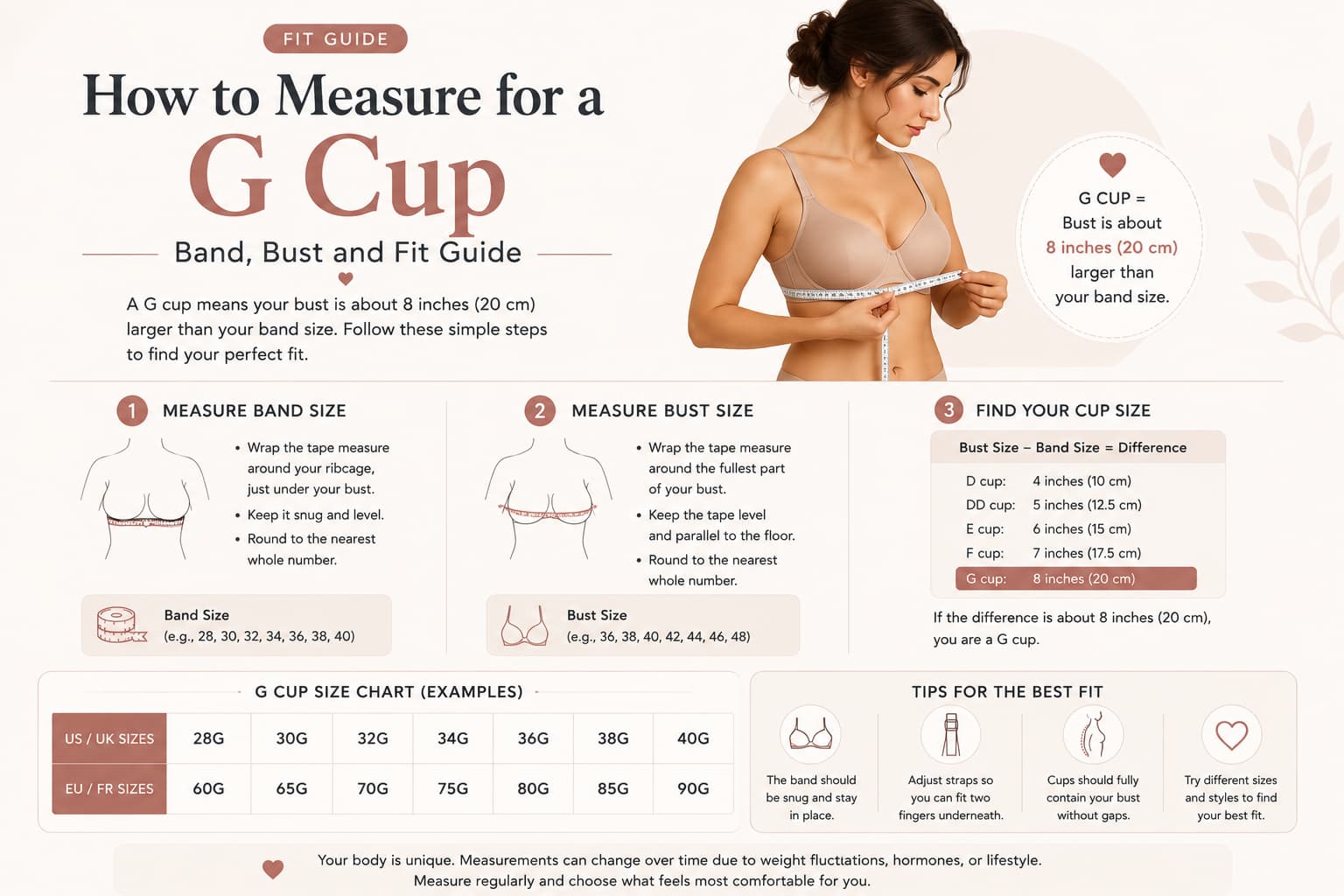
To measure for a G cup, measure your underbust for band size, then measure the fullest part of your bust. The cup letter comes from the bust-band difference. Because G cup measurements vary by country and brand, compare your result with the brand chart before choosing.
How do you measure for a G cup?
You measure for a G cup by taking your underbust and fullest bust measurements, then comparing the difference with a size chart.
For SG/MY users, it helps to compare both inch-based sizes such as 32G, 34G, 36G, 38G and 40G, and cm-based sizes such as 60G, 70G, 75G, 80G, 85G and 90G.
- Prepare a soft measuring tape: use a flexible tape and stand naturally in front of a mirror.
- Measure underbust: wrap the tape around your ribcage directly under the bust. This helps find your band size.
- Measure fullest bust: wrap the tape around the fullest part of your bust without pulling tightly.
- Calculate the difference: subtract the band measurement from the bust measurement.
- Compare with a size chart: check whether the difference sits near G or GG in the brand’s sizing system.
- Check real-life fit signs: confirm that the band, cups, straps, front area and side coverage feel smooth and secure.
What measurements usually make a G cup?
A G cup usually means a larger bust-band difference, but the exact measurement range depends on the country and brand chart.
In many UK-style inch-based systems, G may sit after F and FF, while GG may sit one step after G. In other systems, the naming can change. This is why your measurement result should be checked against the specific brand chart, not only a general cup letter guide.
Gentle reminder: G cup and GG cup are measurement labels, not body labels. The most helpful size is the one that lets the band feel steady, the cups feel smooth and your day feel comfortable.
How to calculate cup size
You calculate cup size by subtracting your band measurement from your bust measurement, then matching the difference to a cup letter.
The table below is a simple guide for fuller cup letters. Use it as a starting point only, because DD, E, F, FF, G and GG can be named differently across UK, US, EU and Asian charts.
| Cup Letter | Common Inch Difference Guide | Approx. cm Difference Guide | Simple Meaning | Fit Note |
|---|---|---|---|---|
| DD | Around 5 inches | About 12–14 cm | Fuller than D in many charts | May be labelled E in some systems. |
| E | Around 6 inches | About 15–16 cm | Often between DD and F | Country naming can vary. |
| F | Around 7 inches | About 17–19 cm | One step below FF in many UK-style charts | Check whether the brand uses FF. |
| FF | Around 8 inches | About 20–21 cm | Often between F and G in UK-style sizing | Not every brand uses double letters. |
| G | Around 9 inches | About 22–24 cm | A fuller cup letter after F/FF in many charts | Confirm with the brand’s own chart before buying. |
| GG | Around 10 inches | About 25–27 cm | Usually one step above G in UK-style sizing | May not appear in every country’s chart. |
How to convert G cup into cm-based sizes
You convert G cup into cm-based sizes by matching your underbust band category with the G cup letter in a cm-style chart.
Many SG/MY shoppers may see labels such as 60G, 70G, 75G, 80G, 85G and 90G. The number usually relates to the underbust band category in centimetres, while G is the cup letter.
| Inch-Based Size | Common cm-Based Label | What to Check |
|---|---|---|
| 28G | 60G | Check if the underbust falls into the brand’s 60 band range. |
| 32G | 70G | Check if the brand treats 32G and 70G as equivalent. |
| 34G | 75G | Often used for a medium band category. |
| 36G | 80G | Often used for a fuller band category. |
| 38G | 85G | Check side coverage and band support carefully. |
| 40G | 90G | Confirm the exact size range on the product page. |
Because brand sizing can vary, always compare your actual underbust and bust measurements with the brand’s own chart before choosing a G cup bra size.
How should a G cup bra fit?
A G cup bra should fit with a level band, smooth cups, secure coverage and supportive fabric that feels comfortable during movement.
After measuring, use this checklist to confirm whether your result works in real life.
- Band sits level: the band should stay even around your body and feel steady.
- Cups do not gape: the cup edge should sit smoothly without open space.
- Cups do not overflow: the bust should not spill over the top or sides.
- Straps do not carry all the support: most support should come from the band and cup structure.
- Center/front area feels comfortable: the front should rest without sharp pressure.
- Cup edge sits smoothly under clothing: the cup line should not press or fold under daily outfits.
- Fabric feels supportive without digging in: support should feel steady, not restrictive.
- Side and top coverage feel secure during movement: check fit while sitting, walking and raising your arms.
Product recommendation module
After measuring, always check the product’s size range before choosing. These options are gentle starting points for moving from measurement to supported daily comfort.

VEIMIA Enhanced Anti-sagging Bra
Scene / Use Case: Post-Measurement Support
Product image URL: https://img.myshopline.com/image/store/1712746823641/enhanced-anti-sagging-bra-anti-gravity-lift-skw5001.jpg?h=1000&w=750
Why it fits this scene: helps users move from measurement to a steadier everyday fit.
Price: Check latest price
Anti-sagging Bra Size range check required Shop Now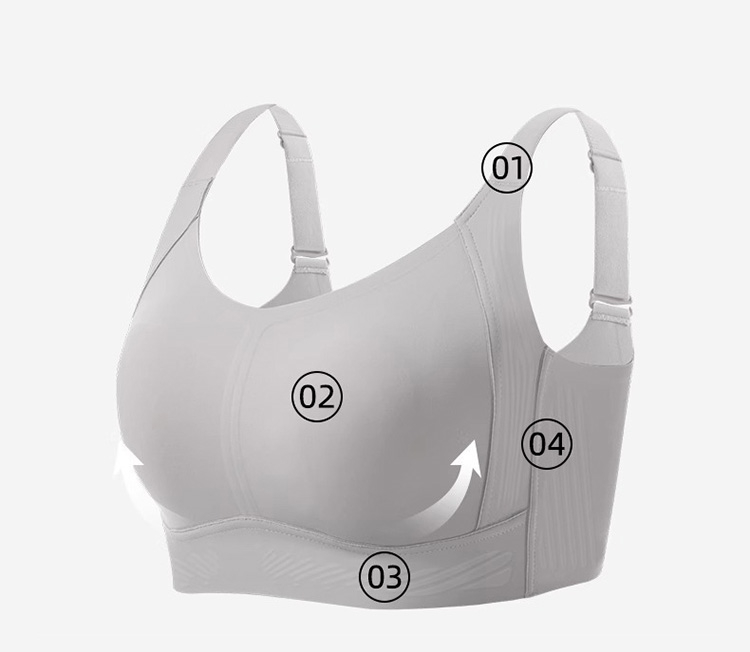
VEIMIA Seamless Back Smoothing Minimizer Bra
Scene / Use Case: Fuller Coverage
Product image URL: https://img.myshopline.com/image/store/1712746823641/best-minimizer-bra-xbb2085.jpg?h=652&w=750
Why it fits this scene: offers more coverage and a smoother outline when the size range matches.
Price: Check latest price
Minimizer Bra Size range check required Shop Now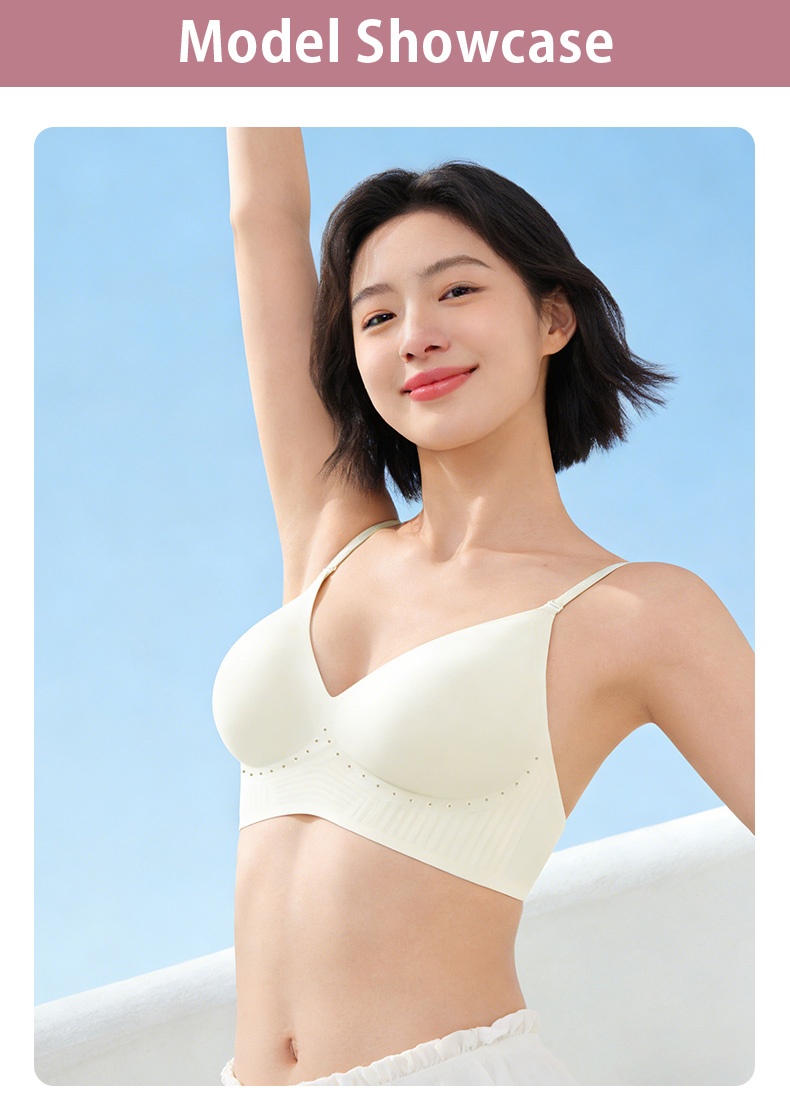
TRENDING VEIMIA Airy Seamless Bra
Scene / Use Case: Smooth Daily Fit
Product image URL: https://img.myshopline.com/image/store/1712746823641/airy-seamless-bra-with-spaghetti-straps-skw3463.jpg?h=1106&w=790
Why it fits this scene: works well under daily outfits when users confirm their correct band and cup size.
Price: Check latest price
Seamless Bra Size range check required Shop NowWhat to do if you are between F, G and GG cup
If you are between F, G and GG cup, compare the brand’s chart and your real-life fit signs before changing size.
Small measurement differences can sit between cup letters, especially around fuller cup sizes where country naming can vary. A cup that feels close but not quite right may need a sister size, a different cup shape or a different coverage level.
- If F overflows but the band feels right: compare G in the same brand.
- If G gapes at the top: try a different cup shape before sizing down.
- If G overflows while the band feels steady: compare GG in the same chart.
- If the band rides up: the band may be too loose, even if the cup feels close.
- If straps dig in: check band support and cup coverage, not only strap tightness.
FAQ
Q1: How do I know if I am a G cup?
A: You may be a G cup if your bust-band difference matches the G cup range on the brand’s size chart and the bra fits smoothly without gaping, overflow or band discomfort.
Q2: What is G cup measurement in cm?
A: In many fuller-cup guides, G cup may sit around a 22–24 cm bust-band difference, but this varies by country and brand, so always check the brand’s chart.
Q3: Is G cup always the same in every country?
A: No, G cup is not always the same in every country. UK, US, EU and Asian charts may use different cup progressions, especially around F, FF, G and GG.
Q4: What if I am between F and G cup?
A: If you are between F and G cup, compare both sizes in the same brand and check whether F overflows or G gapes. Cup shape can also affect the result.
Q5: What if I am between G and GG cup?
A: If you are between G and GG cup, check the same-band comparison first. GG may help if G overflows, but a different cup shape or sister size may also solve the fit issue.
Q6: What if my G cup bra gaps or overflows?
A: If your G cup bra gaps, the cup may be too deep or the shape may not suit you. If it overflows, the cup may be too shallow or the band may be affecting the fit.